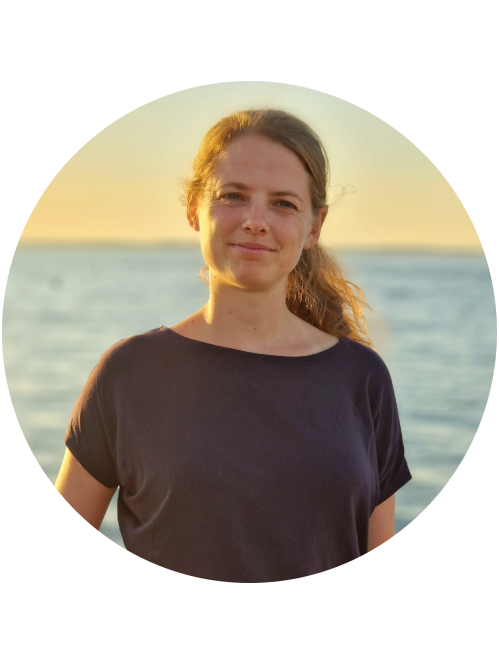
Sabrina Kunzweiler
Researcher in Cryptography and Number Theory
Researcher in Cryptography and Number Theory
I am a tenured research scientist (ISFP) at Inria Bordeaux in France and member of the Canari team. Before joining Inria, I was part of the cryptography group at Ruhr University Bochum in Germany. I completed my PhD in December 2020 at the Institute of Algebra and Number Theory at Ulm University under the supervision of Stefan Wewers.
New preprint with Thomas Decru: Abelian surfaces in Hesse form and explicit isogeny formulas accompanied by a SageMath package to work with elliptic curves and abelian surfaces in Hesse form.
New paper with Min-Yi Shen: Endomorphisms via splittings accepted at PQCrypto 2026
With Luca de Feo, I will teach a course on isogeny-based cryptography at the CIMPA research school on Arithmetic, coding and cryptography at the National Higher School of Mathematics Sidi Abdellah in Algiers (April 05 - April 16, 2026)
I'm invited to give a talk at Algorithmic Number Theory Symposium (ANTS XVII) at Rijksuniversiteit Groningen, Netherlands (July 06 - July 10, 2026).
With Elisa Lorenzo García and Stefano Marseglia, we are organizing a Workshop on Computational Number Theory (July 13 - July 15, 2026) as part of FOCM 2026 at the University of Vienna. The focus of our workshop is on elliptic curves, abelian varieties, isogenies and their cryptographic applications.
Most of my academic degrees are from Ulm University in Germany. But I also studied one year at the Universidad de Cantabria in Spain during my Bachelor, and participated in a double-degree program with Syracuse University in the United States during my Master.
Ph.D. in Mathematics, Ulm University, 2020
M.S. in Mathematics, Ulm University, 2018
M.S. in Mathematics, Syracuse University, 2017
B.S. in Mathematics, Ulm University, 2015
I'm interested in computational aspects of number theory, algebraic geometry and the applications to cryptography. Some of my research topics:
I'm currently working on algorithms for computing isogenies of principally polarized abelian varieties. These algorithms have applications in isogeny-based cryptography which is one of the proposals for post-quantum cryptography. In general, I'm interested in investigating higher-dimensional analogues of cryptographic protocols based on elliptic curves.
I study cryptographic protocols based on group actions, in particular the CSIDH group action. This includes the security analysis of such schemes, the development of generic models, and the design of new protocols.
During my PhD I studied the computation of models of curves and developed algorithms for computing the lattice of integral differential forms. Related to this topic, I also like to think about conductor-discriminant inequalities.
Most of my work includes some explicit computations, algorithms or formulas. Here, you'll find links to the code supporting the publications (written by my coauthors or me).
Superelliptic curves (with Stefan Wewers). This SageMath package can be used to compute the lattice of integral differentials of a superelliptic curve.
SageMath package about cluster pictures by Alex J. Best and Raymond van Bommel. The package includes my formulas for computing integral differentials on hyperelliptic curves with semistable reduction; and you can also compute many more local invariants (see our User's guide to the local arithmetic of hyperelliptic curves).
Ciani quartics This repository contains some extra material for our paper Reduction types of genus-3 curves in a special stratum of their moduli space. In particular, there is SageMath code to compute the semistable reduction of a given Ciani quartic.
(3,3)-isogenies (with Thomas Decru). The repository contains symbolic proofs for the splitting and gluing formulas that we found, and an implementation of our algorithm for computing (3,3)-isogeny chains. You can use it to break the SIKE challenges!
Richelot isogenies The repository contains different algorithms for computing chains of (2,2)-isogenies. This includes the algorithms developed in Efficient computation of (2n,2n)-isogenies, and some newer versions, working on the Kummer surface. You can also use this to break the SIKE challenges.
Modular polynomials (with Damien Robert). This SageMath Package contains the implementation of a new algorithm for computing modular polynomials of elliptic curves. The algorithm is based on the theory of deformations and also uses the (2,2)-isogeny chains from above.
ThetaCGL This repository contains an implementation in Rust of our cryptographic hash function ThetaCGL using radical isogenies in dimensions 1,2 and 3. We also provide an implementation in SageMath which is meant as an educational resource.
Level-3-Arithmetic This SageMath Package implements basic functionality to work with elliptic curves and abelian surfaces in Hesse form. In particular, it includes an algorithm to compute 3-isogenies.
I taught or led research groups at the following events.
Women in SAGE - Nigeria: collaborative conference addressed to young African researchers (University of Ibadan, Nigeria)
Autumn School on Isogenies: school preceding the ECC Workshop 2024 (Academia Sinica, Taiwan)
Effective Algebra and the LMFDB: CIMPA school 2025 (Makerere University, Uganda)
Post-quantum cryptography in Bilbao: Summer School 2025 (Basque Center for Applied Mathematics in Bilbao, Spain)
Mathematical cryptography and algorithms in number theory: Preliminary Arizona Winter School 2025 (online - organized by the Southwest Center of Arithmetic Geometry, USA)
In Ulm and Syracuse, I was a teaching assistant for the following courses.
Calculus II at Syracuse University (Fall 2016, Spring 2017)
Elements of Abstract Algebra at Ulm University (Fall 2017)
Seminar about geometry at Ulm University (Fall 2017)
Elementary Number Theory at Ulm University (Spring 2018, Spring 2020)
Seminar about primality testing at Ulm University (Spring 2018)
Linear algebra I at Ulm University (Fall 2018, Fall 2019)
Linear algebra II at Ulm University (Spring 2019)
Diophantine Equations at Ulm University (Fall 2019)